Newsletter Subscribe
Enter your email address below and subscribe to our newsletter

Enter your email address below and subscribe to our newsletter
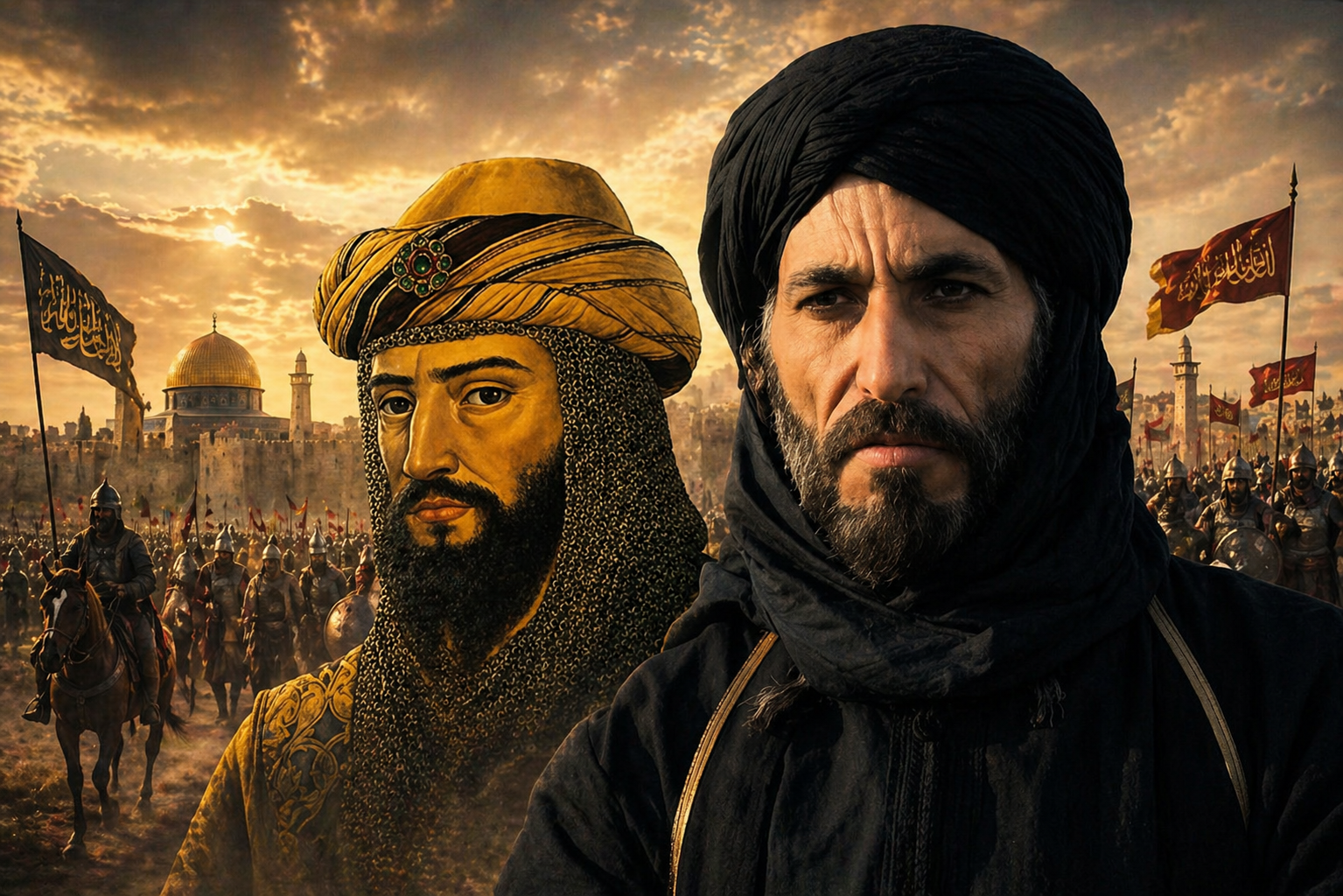
Imagine a blacksmith, born in France, who has never used a sword to fight before in his life; he now finds himself leading the defenses of Jerusalem against one of the greatest military minds in the history of the Middle Ages. This sounds like a fantastic piece of pure Hollywood fiction, but in fact, it forms the core of Ridley Scott‘s 2005 film Kingdom of Heaven.
However, there are several things that most people do not ask about once they have finished watching the movie: How much of this was true? What would the actual story of Saladin and the crusades be, the version that does not include slow-motion cavalry charges or a love interest with convenient timing for plot purposes?
The truth is, while often as fascinating as the fictional account of the events, it is also disturbingly different from that which we saw on screen.
To comprehend both the Kingdom of Heaven and Saladin, you should be aware of the political landscape in which they existed (the Middle East) during the late twelfth century. In this time frame, the “Crusader States,” or what we refer to as Outremer (meaning “overseas”), were weakly established Christian realms established after the First Crusade had captured Jerusalem in 1099.
By 1184, at which point the movie takes place, the kingdoms of the Crusaders were stretched thinly. Surrounding them was a rapidly uniting Islamic World; the person who contributed most to this unity was Saladin, Sultan of Egypt and Syria.
The Crusader Kingdom was a veritable powder keg of geopolitics. The internal division amongst the moderates (who had come to learn how to live alongside the Muslims) and the hardliners (who were bent on perpetual holy war) was only a matter of time before some external force ignited that fuse.
Scott’s film does capture something real here. The tension between Baldwin IV (the “Leper King”), the moderate lord Tiberias, and the war-hungry Reynald de Châtillon is historically grounded. These power dynamics, the internal fractures of a state under siege, genuinely threatened the kingdom’s survival long before Saladin arrived.
1099
First Crusade captured Jerusalem. Crusader states were established across the Levant.
1174
Saladin becomes the Sultan of Egypt. Begins methodically unifying the Muslim world around Jerusalem as the symbolic prize.
1185
Baldwin IV dies. The Crusader kingdom falls into a succession crisis, exactly the vulnerability Saladin was waiting for.
1187
Battle of Hattin. Saladin annihilates the Crusader army. Jerusalem falls shortly after.
1192
Third Crusade ends. Richard I of England and Saladin agree on a truce. Jerusalem remains under Muslim control, but Christians retain access for pilgrimage.
Of all the characters in Kingdom of Heaven that are portrayed as a “historical” figure, the portrayal of Saladin by actor Ghassan Massoud is both the most accurately representative and also the most misleading. That much is true about the real Saladin; he was a man of dignity and restraint, and with deep humanity. In fact, the real Saladin was known to be a chivalrous man, who was generous and would not allow massacres of civilian populations upon the surrender of Jerusalem in October of 1187. When the city fell, Saladin specifically prohibited the killing of civilians. Thousands were ransomed. Christians living within the city walls could leave unharmed.
Saladin’s mercy after taking Jerusalem was so striking that European chroniclers, his enemies, wrote about it with barely concealed admiration.
Compare this to the massacre of Muslims, Jews, and Eastern Christians by crusade forces when they captured Jerusalem in 1099. Medieval observers were well aware of the difference between then and now, and so are historians today.
While Saladin’s military strategy is well-known, what the film does not do justice to is his diplomacy. Before he ever raised his sword against the crusades, he spent years carefully weakening rival muslim powers, including the Zengid dynasty, various Abbasid factions, and Egyptian dissidents. He knew that diplomatic effort and military force were two faces of the same coin.
Think of it this way: chess is like diplomacy. Saladin was playing ten moves ahead while everyone else was still setting up the board.
The Battle of Hattin in July 1187 was one of the most important battles in all of medieval warfare. While the battle at Hattin is a central part of the movie “Kingdom of Heaven,” that battle is the whole reason why the movie was made; without it, the siege of Jerusalem depicted so dramatically in the film would have never occurred.
That is when history really surpasses the drama presented by Scott on screen.
Saladin did much more than simply win at Hattin; he deliberately planned and executed a systematic campaign to destroy the Crusader Army using many of the same elements we would see today as part of a contemporary military textbook (intelligence, patience, and psychological operations).
He intentionally took the Crusader Army away from its water source in the blistering July heat of the Galilean Region.
He started fires among the dry grass surrounding the Crusader Camp, which choked them with smoke and intensified the already extreme temperatures.
Through the night, he tormented them with drumming and chanting so they could get little rest.
When the battle began in the early morning hours of that day, there was little left in the Crusader Army to fight for; they had lost all of their fluid, were exhausted, and their morale was broken down – prior to one single stroke of a sword being made.
Approximately 15,000 Crusader Soldiers died or were taken prisoner. The True Cross (the most sacred relic of Christianity) was taken by the crusaders. This relic was never seen again.
The film portrays some of these events (but condenses/simplifies); it does not show the total magnitude of what occurred. In fact, the loss of Hattin resulted in nearly the complete loss of combat capability by the entire Kingdom of Jerusalem within one afternoon.
We need to be systematic in our review. Historians have been researching Ridley Scott’s film for many years since its release, especially after Ridley Scott released his Director’s Cut, which has received so much praise from historians as being a much more historically accurate film than the original theatrical version.
✓ Historically Accurate
✗ Hollywood Invention
If there is one single significant historical sin committed by this movie, it is Balian himself.
Balian, as portrayed by Orlando Bloom, is a simple blacksmith who finds out that he is actually of noble blood (a very much modern action-hero type) through a rather unorthodox means.
In contrast to this portrayal, Balian of Ibelin, a notable Crusader leader, was indeed an influential man in his own right. He was quite rich, had experience with war, and was well entrenched in the politics of Outremer.
As such, he had participated in many battles. He was married to Queen Maria Komnene (former queen consort of Jerusalem). To put it bluntly, he was probably one of the most important people in the kingdom at that time.
What is interesting about how Hollywood decides to make a powerful member of nobility (such as Balian) an ordinary person and a worker-class blacksmith? The “working-class everyman hero” concept is a very modern way of looking at history; however, medieval society was strictly organized in a hierarchy. No one other than someone like Balian would be able to negotiate with Saladin as equals.
When you remove this from the movie, you do not simply lose a depiction of what really happened. What you are losing is part of the message or lesson of the real story.
You may be thinking about why such an old (medieval) war, 800 years old to be exact, has so many eyes upon it. So I will tell you, honestly, the reason is quite simple: the Crusades continue to be used today as part of political rhetoric by groups along the entire political spectrum and most often without regard to historical accuracy.
Politicians call their opponents “crusaders.” Groups whose ideologies fall on opposite ends of the spectrum refer to the battles at Hattin and Jerusalem as examples of modern-day wars. To put it bluntly, there is no way of understating just how important it is to understand what occurred and its complexities in order to make sense of this history because, unfortunately, this history continues to be brought into present-day political arguments.
In contrast to a simplistic view of the Crusades as a battle between civilizations or a clear-cut case of oppressor and oppressed, the actuality is far more complex. The Crusades represent a long series of geopolitical struggles among shifting alliances over a period of centuries.
For example, Saladin formed alliances with various Christian factions at different times. Conversely, some crusader lords formed alliances with Muslim rulers against common enemies. In addition to the obvious theological differences between the two sides, ordinary people on both sides suffered terribly throughout the course of these conflicts, regardless of which side was able to win the theological debate.
It is also important to remember that the ultimate defeat of the Crusaders was not inevitable but rather resulted from a combination of specific political failures, rivalries, and strategic mistakes that could have been avoided.
For all its artistic liberties, Kingdom of Heaven, particularly in the Director’s Cut version, captures the moral environment of the Crusades better than one would expect. The movie does not reduce this war to a simplistic battle between good Christian crusaders and evil Muslim invaders. There is also evidence of fanaticism, corruption, and cynicism from both sides of the conflict. King Saladin is portrayed as a person who has true principles; his faith and morals are never called into question. The movie raises difficult questions regarding what men will do in the name of God.
Most movies that are based on history have difficulty capturing the larger picture and therefore do not capture the essence of the subject. That’s exactly how Kingdom of Heaven works. Although some historians may cringe at many of the factual aspects of the movie, they still enjoy the overall theme and message.
Absolutely, but see it only as a meditation on the time of the crusades; don’t look at this film as if it were a historical documentary. You can find an accurate account of Saladin, the battle of Hattin, and the capture of Jerusalem in many fine books and academic works.
The true story of that time period? It is far greater, far more complex, and far stranger than what Ridley Scott had the courage to portray.
Disclaimer: This article is for informational and educational purposes only. It reflects analysis based on publicly available geopolitical developments and does not constitute prediction or professional advice.
Want More Guides on Historical Analysis? Check out this One