Newsletter Subscribe
Enter your email address below and subscribe to our newsletter

Enter your email address below and subscribe to our newsletter
Imagine that a car makes a wrong turn down a small street, and as a result, twenty million people are dead.
It is not a metaphor. This is actual historical fact. It is a very frightening aspect of World War I that many people do not fully appreciate or understand.
Archduke Franz Ferdinand, the heir to the Austro-Hungarian throne, narrowly escaped an assassination attempt on June 28, 1914, in Sarajevo. His motorcade was shaken and had to take a new route out of the city. In this process, his driver made a wrong turn, and the motorcade passed directly in front of a café. At that exact time, Gavrilo Princip, the man who attempted the assassination earlier that day, was sipping coffee inside the cafe. He took advantage of the situation and shot both the archduke and his wife with two bullets. And the world would never be the same again.
However, there were no bullets that actually started World War I. The firing of the two bullets merely lit the fuse to detonate the powder keg. The powder had accumulated over decades from multiple areas: entangled alliances, wounded national pride, imperial ambitions, and a fragile international diplomacy system.
The complete account of how one wrong turn led to the worst war humanity has yet to experience and how we can continue to apply the lessons learned from all three regarding geopolitics, power, and the frightful fragility of peace.
To comprehend World War I, one has to also comprehend Europe in 1914. At first glance, it appeared nearly civilized, with great powers having large empires, successful economies, and diplomatic systems of various types. However, there was an enormous amount of instability hidden behind that seemingly civilized facade.
The Alliance System: A Web of Invisible Strings
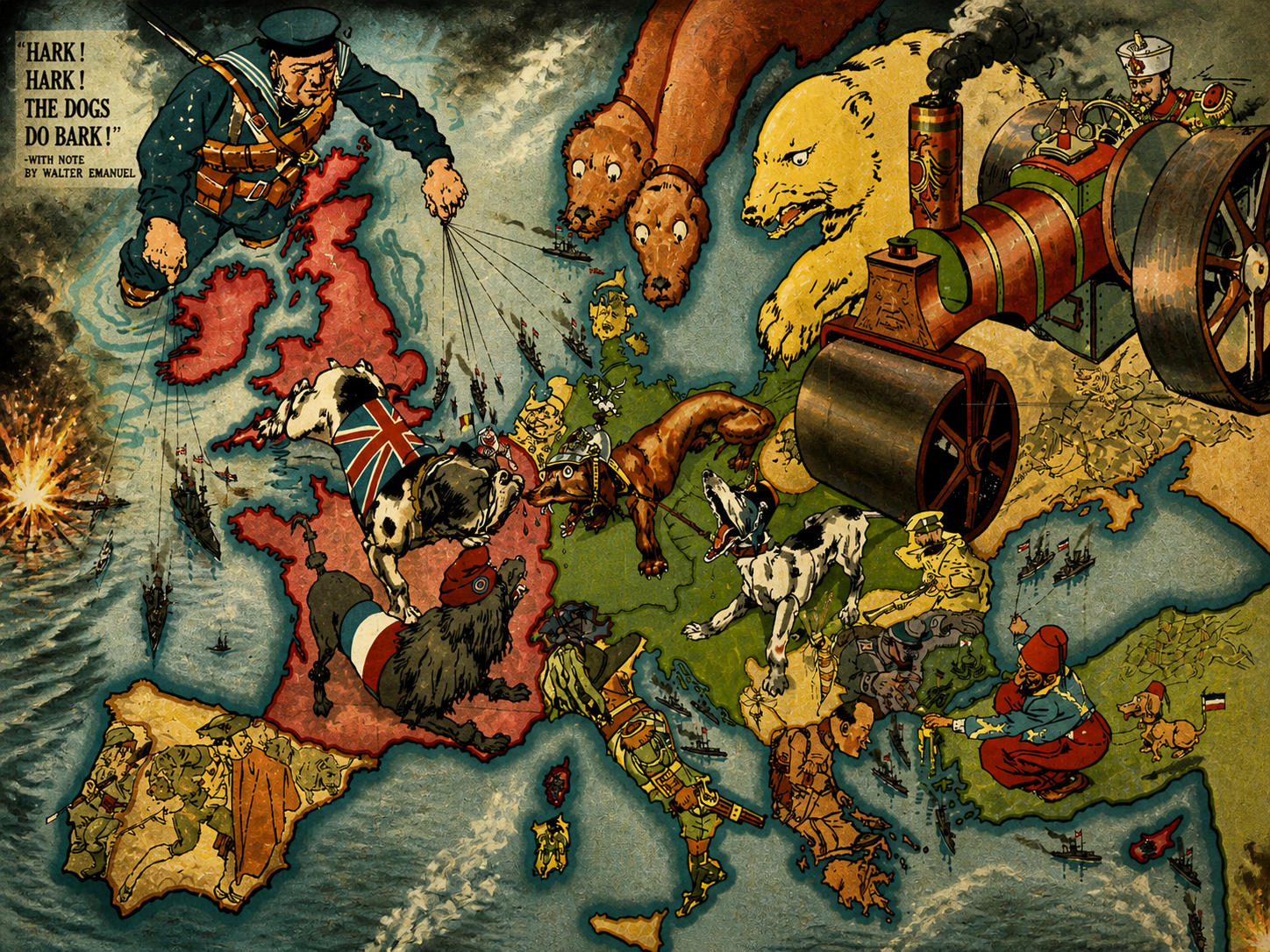
Consider pre-war Europe as a game of chess. Every chess piece is linked to the others through a network of invisible strings. If you pull on one string, everything else will follow.
At this point (by 1914), Europe had divided itself into two opposing groups:
Both alliances were designed to offer protection. In fact, the idea behind both alliances was quite simple: if someone attacked one member of either group, then all members of that group would be attacked. Unfortunately, once the next major conflict occurred after these alliances were established, the logical implications of those alliances turned out to be disastrous. Alliances between countries are based on the premise that conflicts can be resolved through peaceful means. However, by 1914, each nation had essentially created a web that no longer allowed it to remain neutral.
Diplomacy in Theory and Practice
In theory, diplomacy is like a delicate dance. By 1914, however, every participant in that dance was carrying a gun, and the tempo of the music had changed dramatically.
The Arms Race: Greater Numbers of Troops; Less Time Between Battles
In addition to forming alliances among themselves, the European states had engaged in a significant arms race over the previous few decades. The German Navy was being increased. As a result of their fear of losing control at sea, Great Britain decided to build even larger fleets. Russia was also updating its Army. Additionally, Austria-Hungary was watching the Serbians with increasing suspicion.
Military expansion was not simply a matter of public policy; militarism had become a part of the culture. Military officers were idolized. Warfare was glorified. Young men throughout Europe truly believed that a short but magnificent war would resolve long-standing issues and restore national pride.
No one could imagine how warfare conducted using weapons manufactured on an industrial scale would really work.
Historians use the acronym MAIN militarism, alliances, Imperialism, nationalism to describe the causes of World War I. Although it is a valuable tool for understanding what led to World War I, it oversimplifies and makes the events that occurred less personal.
1- Nationalism: pride, which will never be satisfied
Nationalism was the leading movement in the early twentieth century. It was a very powerful desire for independence, respect, and the ability to build one’s own country. It created some new nations. Nationalism has also caused the downfall of many countries.
Balkan nationalism was particularly volatile due to the fact that there are so many different ethnic groups in the area, including Serbs, Croats, Bosnians, and Slovenes who desired their independence from Austria/hungary, which was collapsing at that time. After the success of the Balkan Wars (1912-1913), a young and newly confident Serbia began dreaming about unifying all South Slavic peoples under one government.
As Austria-Hungary looked at this growing nationalistic sentiment, it became increasingly fearful of an expansive and aggressive Serbia. So when a Serbian nationalist assassinated Archduke Franz Ferdinand of Austria-Hungary, Vienna did not view this as simply the assassination of a man. Instead, they viewed it as a declaration of war.
2- Imperialism: competing for global power
By the end of the nineteenth century, all of the major powers of Europe had divided the entire globe among themselves into either colonies or areas of influence. Therefore, by 1914, almost the globe was taken. As such, the remaining powers competed against each other for control over various aspects of the world, including trade routes, regions of influence, etc.
Although Germany had experienced rapid industrialization in comparison to other European powers, it still sought its place in the sun, i.e., its share of the global power structure. The existing imperial powers (Britain and France) were intent on retaining their positions in the hierarchy. Thus, imperialism affected how diplomats acted and thought throughout Europe.
3- The failure of diplomatic efforts
One of the most tragic causes of World War I may be that it could have potentially been avoided. Many leaders on both sides could have retreated at some point. However, they did not do so because of pride, error in judgment, and a false assumption that the opposing party was bluffing. Kaiser Wilhelm II of Germany was irresponsible and insecure. He needed to show Germany’s strength.
Tsar Nicholas II of Russia was pressured by his military to stand firm after decades of national humiliation. Britain’s foreign policy was ambiguous enough that Germany believed Britain would not take action if it went to war.
Each side in this international diplomacy chess match misinterpreted its opponent’s intentions.
The Assassination of Archduke Franz Ferdinand on June 28, 1914, was the catalyst for a series of events that would unfold in just 37 days as both diplomats failed, ultimatums were issued, and mobilizations took place by many nations. Historians have referred to these events collectively as the July Crisis.
June 28, 1914
The Assassination
Archduke Franz Ferdinand and his wife Sophie are shot dead in Sarajevo by Gavrilo Princip, a 19-year-old Bosnian Serb nationalist affiliated with the secret society “Black Hand.”
July 5–6, 1914
Germany’s “Blank Cheque”
Kaiser Wilhelm II gives Austria-Hungary unconditional backing, the infamous “blank cheque” assuring them that Germany will support whatever action they take against Serbia. This emboldened Austrian hardliners, who wanted war.
July 23, 1914
The Ultimatum
Austria-Hungary delivers a harsh 48-hour ultimatum to Serbia with 10 deliberately humiliating demands, designed to be rejected. Serbia accepts 9 of the 10 as an extraordinary concession, but Austria-Hungary declares it insufficient.
July 28, 1914
Austria Declares War on Serbia
Exactly one month after the assassination, Austria-Hungary declared war on Serbia. The alliances begin to activate like dominoes.
August 1–4, 1914
Europe Goes to War
Germany declares war on Russia (Aug 1) and France (Aug 3). Germany invades neutral Belgium, triggering Britain’s declaration of war against Germany on August 4. World War 1 has officially begun.
Most folks anticipated that World War I would end by Christmas when it began. Military leaders on each side envisioned a short, decisive campaign similar to the type of wars they remembered their grandfathers fighting.
Unfortunately, they were grossly incorrect.
Trench Warfare: The Horrors of an Entire Generation
By weeks into the battle, the war had evolved into a style of combat known as trench warfare, a never-before-seen static and gruesome form of combat on the Western Front. Miles upon miles of muddy trenches stretched across northern France from Belgium to Switzerland. Soldiers lived like wild beasts; in cold, filthy, disease-ridden ditches with nothing but machine gun fire, poison gas, and artillery bombardments that could decimate thousands per day.
In July 1916, during the Battle of the Somme, Britain experienced 57,470 casualties in just one day, still the largest number of casualties experienced by Britain in a single day. In January 1917, after almost ten months, the Battle of Verdun ended with hundreds of thousands dead on both sides, with little or no strategic advantage gained by either side.
These realities were created through the unbridled force of nationalism and imperialism, neither of which produced great victories. Only dirt, gas, and massive loss of life resulted.
Technologies of Mass Destruction Evolve
World War I was the first industrial-scale war. Factories that previously fueled the European economy now turned out mass-produced death in various forms:
When combined, old-fashioned military strategies and modern technological advancements proved disastrous. Cavalry units continued to charge headlong into machine guns. The difference between new technologies and old strategies led to the deaths of millions.
On the day after Armistice Day (November 12th), when the guns were finally quieted on November 11, 1918, there is no way to describe the destruction; four Empires had been toppled (the Austro-Hungarian, the Ottoman, the Russian, and the German); the entire European continent had been completely redone.
In 1919, the Treaty of Versailles was intended as a source of eternal peace. However, instead of providing an enduring foundation for world peace, the Treaty provided the seeds of another disaster. In addition to being held totally responsible for the war through the infamous “War Guilt Clause”, Germany lost large amounts of land and was burdened by massive reparations, which severely damaged their economy.
Twenty years later, Adolf Hitler would rise to political prominence using this same humiliation and economic devastation to launch World War II.
World War I did not end the wars. It merely delayed them.
Why does learning the history of WWI go beyond a simple history lesson? It’s an active warning to our present situation.
How many similarities do we have between now and 100 years ago? Global superpowers competing geopolitically; local conflicts putting greater forces on the line; and multiple alliances under test and renegotiation. And economic reliance coexists with the same high levels of political conflict as 100 years ago.
The Dangers of Miscalculation
World War I has one very important message about how quickly miscalculation can spin out of control. None of the leaders in 1914 wanted a four-year global war resulting in 20 million deaths. They simply miscalculated. They postured. They thought their opponent(s) would give way. They did not.
Now we’re living in a world with nuclear weapons. The consequences of miscalculating similarly will be far more devastating. The Cuban Missile Crisis in 1962 nearly proved the lesson from World War I again. The current rising tensions in the South China Sea, Eastern Europe, and the Middle East all bear some resemblance to what occurred in 1914.
Why Alliances Work Two Ways
Alliances make you safer, but they restrict your choices. When you agree to defend another country’s ally, you may get pulled into wars you didn’t choose. Today’s NATO (North Atlantic Treaty Organization), CSTO (Collective Security Treaty Organization), and various other forms of alliances represent the exact same type of thinking that existed in 1914. Thus, the risk is there again.
Modern diplomats have to try to protect the deterrents provided by alliances while avoiding the automatic expansion that created the catastrophe of 1914.
The Price of Ignoring Regional Conflict
Sarajevo is a regional city in a volatile region of the Balkans. To most of the major European capital cities, Sarajevo represented a remote area that was of little concern. However, it was. Regional conflicts within highly interconnected systems are no different than large scale conflicts. They contain potential fuse(s).
Foreign Policy Experts are warning us about this very issue regarding numerous “hot spots” around the globe today. A miscalculation over Taiwan, Kashmir, or the Persian Gulf could theoretically start the same chain reaction as happened when a driver took a wrong turn in Sarajevo in 1914.
A driver got lost. A young man armed with a pistol happened to be in the wrong place at the right time. Two shots were fired on a lovely June day in Sarajevo.
Twenty million people would die as a result.
However, the true lesson of World War I is NOT about getting lost or being in the right (or wrong) place at the wrong (right) time. The true lesson of World War I is what happens when nations allow pride to get in the way of reason; when national interests are replaced by collective agreements (alliances); and when leaders confuse aggressive behavior with strength.
The structure of 1914 nationalism, militarism, imperialism, and weak diplomacy did not simply disappear after the Armistice. These structures have developed. They are still here today.
Disclaimer: This article is for informational and educational purposes only. It reflects analysis based on publicly available geopolitical developments and does not constitute prediction or professional advice.
Want More Guides on Historical Analysis? Check out this One