Newsletter Subscribe
Enter your email address below and subscribe to our newsletter

Enter your email address below and subscribe to our newsletter
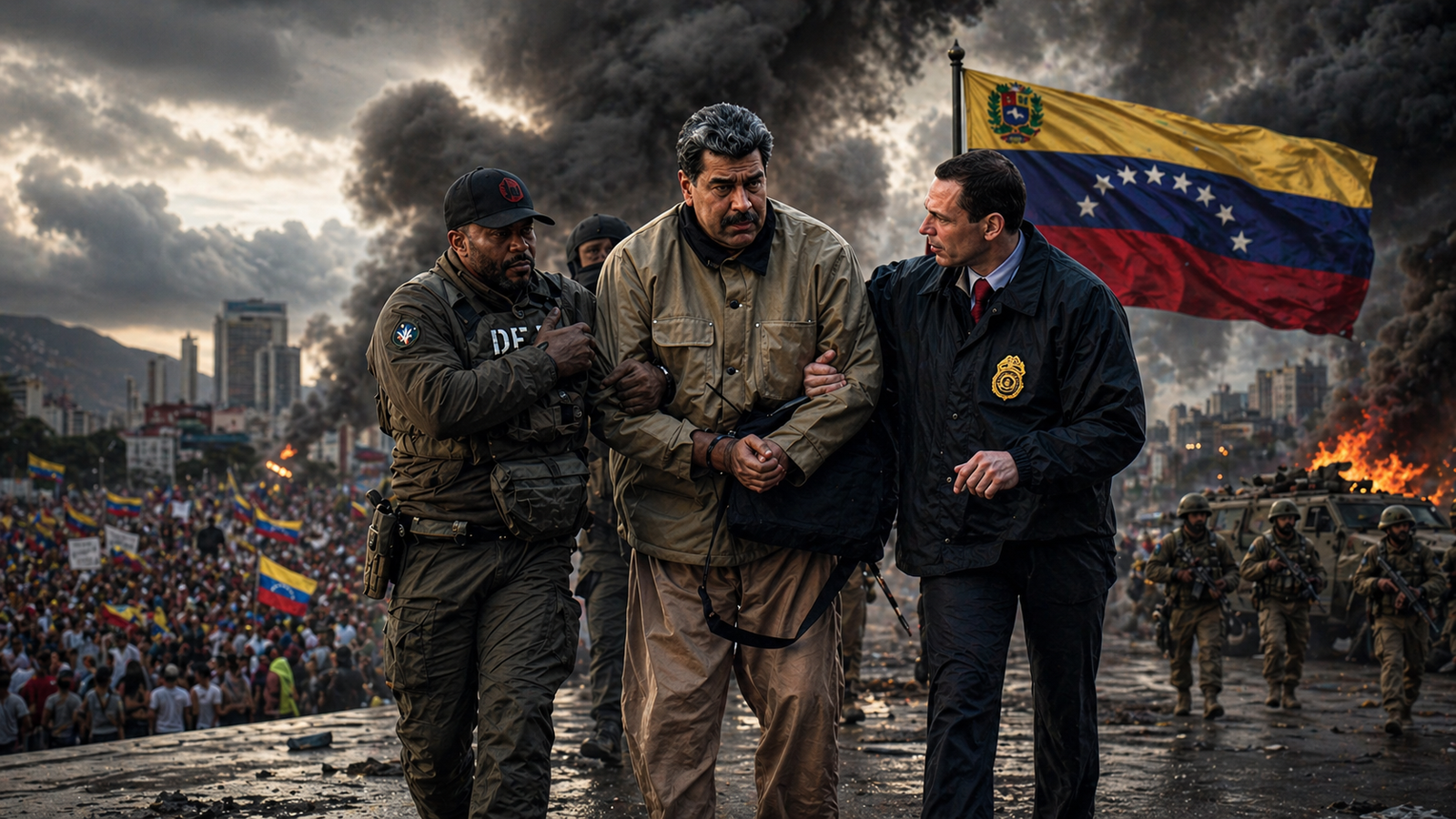
Imagine waking up one day to discover the president of your own country is gone; he didn’t lose an election or resign. Instead, foreign special operations forces stormed his private residence early in the morning and flew him halfway around the world for trial. That’s no Tom Clancy novel. That’s what happened in Venezuela on Jan. 3, 2026.
Early on that Saturday morning, U.S. military personnel conducting Operation Absolute Resolve forcibly removed Nicolás Maduro and his wife, Cilia Flores, from their Caracas home. By that afternoon, they had arrived in America. And by that night, President Donald Trump held a news conference at Mar-a-Lago announcing that the United States would run Venezuela until a transitional government could be established and that American companies were lining up to spend billions of dollars investing in Venezuela’s petroleum and fuel development.
To be able to understand what is going on today, one has to first see how Venezuela got to this place. It is a story of the loss of an unbelievable amount of potential due to an extreme form of political belief system, corruption, and the continued decline of the world’s largest known oil reserves.
Maduro took over as president after Hugo Chávez died in office in 2013. Maduro was a former bus driver and a union activist. Although charismatic in his own right, Maduro lacked the ideological drive that Chavez had. What Maduro did not lack was ruthlessness. Throughout the next ten years, Maduro solidified his hold on power with the assistance of the compliant Venezuelan Supreme Court, the military, which remained loyal to him, and a national security apparatus that documented the arrest, torture, and disappearance of opposition figures.
By all credible accounts, the 2024 presidential election was rigged. In fact, the opposition candidate Edmundo Gonzalez presented evidence at the precinct level showing that he clearly won the election. However, the National Electoral Council (which is controlled by the government) decided to declare Maduro the winner despite this overwhelming evidence. As such, the United States, the European Union, and several other countries in Latin America refused to accept the results of the election. Due to these developments, protests began. Security personnel responded accordingly to quell these protests.
Although many around the globe condemned Maduro’s actions, he was sworn in for a third term in January 2025. Analysts believe that it was this decision that started a countdown clock that ultimately led to what followed in the subsequent year.
Inherits Chávez’s presidency. Venezuela’s oil output is still near 2.5 million barrels/day, but the decline is already underway due to mismanagement.
2019
Washington imposes a full embargo on PDVSA, Venezuela’s state oil company, cutting off hard currency and triggering hyperinflation. Oil exports to India and Europe collapse.
2020
The U.S. DOJ unseals charges against Maduro, alleging a cocaine-trafficking conspiracy with Colombian guerrilla groups worth billions of dollars.
Jul 2024
Opposition candidate González wins according to independent monitors. The government declares Maduro the victor. Mass protests follow; over 2,000 arrests are reported.
Jan 3, 2026
U.S. Special Forces capture Maduro and his wife in a pre-dawn raid in Caracas. Both are flown to New York to face federal charges, including narco-terrorism and drug trafficking.
To put it bluntly, Venezuela sits on top of the world’s largest oil reserves. That singular fact affects nearly all decisions regarding Venezuela’s future, whether from the Trump Administration, oil companies, China, or Venezuela’s fractured leadership.
It is unfortunate that this reserve was managed catastrophically. Venezuela’s oil and fuel production peaked at 3.5 million barrels per day in the late 1990s. As of January 2026, when US forces arrived in Venezuela, that number plummeted to approximately 800,000 barrels per day, a fraction of what Venezuela could produce during the height of production (less than one-quarter).
Why did it drop off so quickly and precipitously? The decline was multi-authored. Hugo Chavez fired over 18,000 of his best and brightest petroleum engineers from PDVSA after a 2002 strike; they were replaced with politically loyal employees. Deferral of infrastructure spending occurred for many years. Next followed the imposition of US sanctions in 2019 that prohibited critical oil-for-debt agreements and stopped imports of chemical diluents needed to extract Venezuela’s heavy crude. Printing money to pay the State’s debt led to hyperinflation that destroyed the purchasing power of ordinary Venezuelans’ life savings.
Rebuilding Venezuela’s oil industry is the work of a decade, requiring hundreds of billions of dollars in investment.”
Al Jazeera Energy Analysis, January 2026
The next day after the arrest, President Trump stated that the US would be in charge of all Venezuelan oil for sale “indefinitely” and that he had received statements from several American oil companies willing to spend billions to restore the industry. This was an aggressive declaration; however, what the markets responded with was a much more subdued reaction.
Oil prices did not spike; they declined. Brent crude declined to approximately $60/barrel, and WTI crude decreased below $58/barrel. What happened? Since the world oil supply is currently oversupplied, new production is coming online from Brazil, Guyana, Argentina, and within the United States. Additionally, since OPEC+ started removing their voluntarily cuts, the IEA forecasted that supply could outstrip demand by as much as 2 million barrels/day by 2026.
At its best-case scenario (or theoretical maximum), Venezuela’s oil/fuel production simply does not have the same level of influence on geopolitics as it used to. In fact, one analyst said, “The market can absorb Venezuelan barrels. But the market cannot price extended periods of political instability.”
First actions soon followed. The US government reached an agreement with Caracas to allow exports of Venezuelan crude to the United States of up to $2B in value, which involves exporting approximately 30-50M barrels of previously sanctioned oil. This is a beginning, yet given Venezuela is producing less than 1 MBD today, restoring Venezuela’s oil and fuel industry to anywhere near its previous levels will take years and cost tens of billions of dollars.
Venezuela’s petroleum story has always been much bigger than petroleum. In the time of Maduro, Caracas effectively served as an important outpost for U.S. competitors in the Western Hemisphere, at least that is how Washington saw things.
China was Venezuela’s biggest creditor, funding PDVSA with money and developing large-scale mining projects (producing critical minerals used in modern weaponry) throughout Venezuela. Venezuelan oil accounted for approximately 4 percent of China’s total imports at its highest point, not a huge percentage, but they were heavily interdependent. Reportedly, Iran built drone manufacturing plants on Venezuelan land. Also, Russia sent military advisors.
The Trump administration had already indicated in its 2025 National Security Strategy that the relationship between Caracas and Beijing/Moscow represented a significant risk to U.S. interests, “a strategic outpost for rival powers” within the U.S. long-standing sphere of influence. Therefore, Operation Absolute Resolve wasn’t merely a law enforcement operation regarding narcotics. It was an attempt by the United States to sever an economic dependence chain running from Caracas to Beijing to Moscow.
Ultimately, China did not take any action regarding Venezuela. Beijing accepted the new reality. The Council on Foreign Relations stated that there will be greater skepticism among countries in Latin America toward cooperating with China based on the increasing geopolitical costs. Venezuela was China’s most deep-rooted partner under the Belt & Road Initiative in the Americas, and Beijing could do nothing to save it.
This is also where we can see real danger and complexity.
Once Maduro had left Venezuelan soil (and the hardliners within his regime), Delcy Rodríguez (the VP) did not disappear; while in Moscow at the time of the extraction, she claimed to have authority over the country. As well, Defense Minister Vladimir Padrino López took the opportunity to step forward and establish himself as the man in charge of operations in Caracas.
Many analysts and democracy advocates are baffled by how Trump chose to proceed. He failed to recognize Edmundo González (who, by all reliable reports, won the 2024 presidential election) as an acceptable partner. He dismissed opposition leader María Corina Machado, stating that she lacked “respect and support”. Further, he stated that he would be willing to work with Maduro’s handpicked VP if she agreed to his terms.
The Council on Foreign Relations summed it up clearly: without a clear plan for a free election process, what the US has started amounts to nothing less than a “new open-ended foreign occupation focused primarily on oil”, which brings back memories of Iraq in 2003.
Oil output is frequently the central theme of policy debates, as well as geopolitically speaking, Venezuela’s future. However, the true and overwhelming costs to the Venezuelan people will be far too high and should not be drowned out by all of the political rhetoric and debate surrounding the situation.
The United Nations World Food Programme reports that approximately 15 percent, or about four million people, of Venezuela’s overall population currently need urgent food assistance. For many years, Venezuela’s health care system has been in disarray. An estimated seven million Venezuelans have left the country; thus, this represents one of the largest mass migrations in the Western Hemisphere’s history.
Venezuela’s government allocated nearly 78 percent of its annual budget toward social programs (schools, hospitals, etc.) as part of oil revenue generated prior to the present political crisis. Given that oil revenue continues to decline and there appears to be no clear resolution regarding a new political structure in place within the country, Oxford Economics warns of “quick knock-on effects with respect to social spending, which in turn carries with it a risk of social unrest.”
In addition to the uncertainty and instability of investors who wish to commit capital into a project, as is the case now, stability also requires political agreement among stakeholders. A politically agreeable transfer process (transition) is necessary for any type of credibility. Credibility is required for creating a democratic road map that provides a foundation from which a legitimate and peaceful transition can occur.
During the World Economic Forum at Davos, several weeks after Maduro captured power in Caracas, a group of energy professionals collectively made several observations. Jason Bordoff, founding director of Columbia University’s Center on Global Energy Policy, stated that the international oil companies that remain in Venezuela could possibly produce an additional one-third more than what they currently produce if their current equipment is fixed or upgraded. However, he then quickly added that the recovery of the entire oil industry would likely take “tens of billions of dollars and years of continued investment.” He further added that “companies will not invest that amount of money even with the very strong encouragement…of the U.S. president.”
Similarly, Francisco Monaldi, director of the Latin America Energy Program at Rice University’s Baker Institute, indicated in late April 2026 that the most noticeable change in Venezuela’s oil industry since the operation began is where the oil is being exported rather than how much. Prior to the operation, it is estimated that more than 80 percent of Venezuela’s crude oil exports went to China using shadow fleets. After the operation, however, it is reported that the majority of Venezuela’s crude oil is being shipped to U.S. licensed markets.
In history, we can see how events follow similar patterns. The capture of Panamanian President Manuel Noriega by U.S. forces in 1989 and the removal of Iraqi President Saddam Hussein by U.S. military force in 2003 created two identical types of voids that both required many years to some degree rectify. With respect to Iraq, this process continues today (over 20 years later).
At Davos, José Raúl Mulino made the point directly concerning the “day-after” structural challenges as far as “planning” for such an event is concerned, and that when you fail to get this right, it will be the citizens who bear the cost.
Venezuela is not Iraq; however, Venezuela’s crude is heavier and more difficult to extract than that of Iraq, Venezuela’s civil society is much better established than that of Iraq, and the Venezuelan military has not been disbanded like that of Iraq was in 2003. However, the underlying conflict persists: a military operation that removes a national leader does not necessarily establish governance, nor does it create investor confidence or a system of rule of law. These all have to be constructed, and constructing them is exponentially harder than tearing them apart.
Oil and natural gas reserves in Venezuela are among the biggest in the world. Four decades of Chavez have produced much less than the people of this country deserve. The departure of Maduro opens up an opportunity, but there’s no one who has any idea what is going to happen when they go through that doorway.
Capture of a president while he was still in office did little to affect the global commodity market. That tells you a great deal about how the rest of the world sees things: we’re in an environment where we are experiencing supply and demand balance with excess capacity around the world due to all of the shale production, and none of that is dependent upon Venezuelan crude. Over the next 5-10 years, however, if stability can be maintained, rebuilding Venezuela’s oil sector could create a new paradigm for how energy is developed and marketed across Latin America. It could also alter migration patterns. All of these would be significant developments.
These decisions do not exist in some vacuum; rather, these decisions exist as a result of actions taken by decision makers currently in Washington DC, in Caracas, and within the boardrooms of major oil companies who are simply waiting to receive a sign from someone that it is time to start investing again. To 30 million Venezuelans, these decisions represent nothing more than a choice between their future and more of the same.
Disclaimer: This article is for informational and educational purposes only. It reflects analysis based on publicly available geopolitical developments and does not constitute prediction or professional advice.
Want More Guides on Contemporary Politics? Check out this One