
Newsletter Subscribe
Enter your email address below and subscribe to our newsletter

Enter your email address below and subscribe to our newsletter
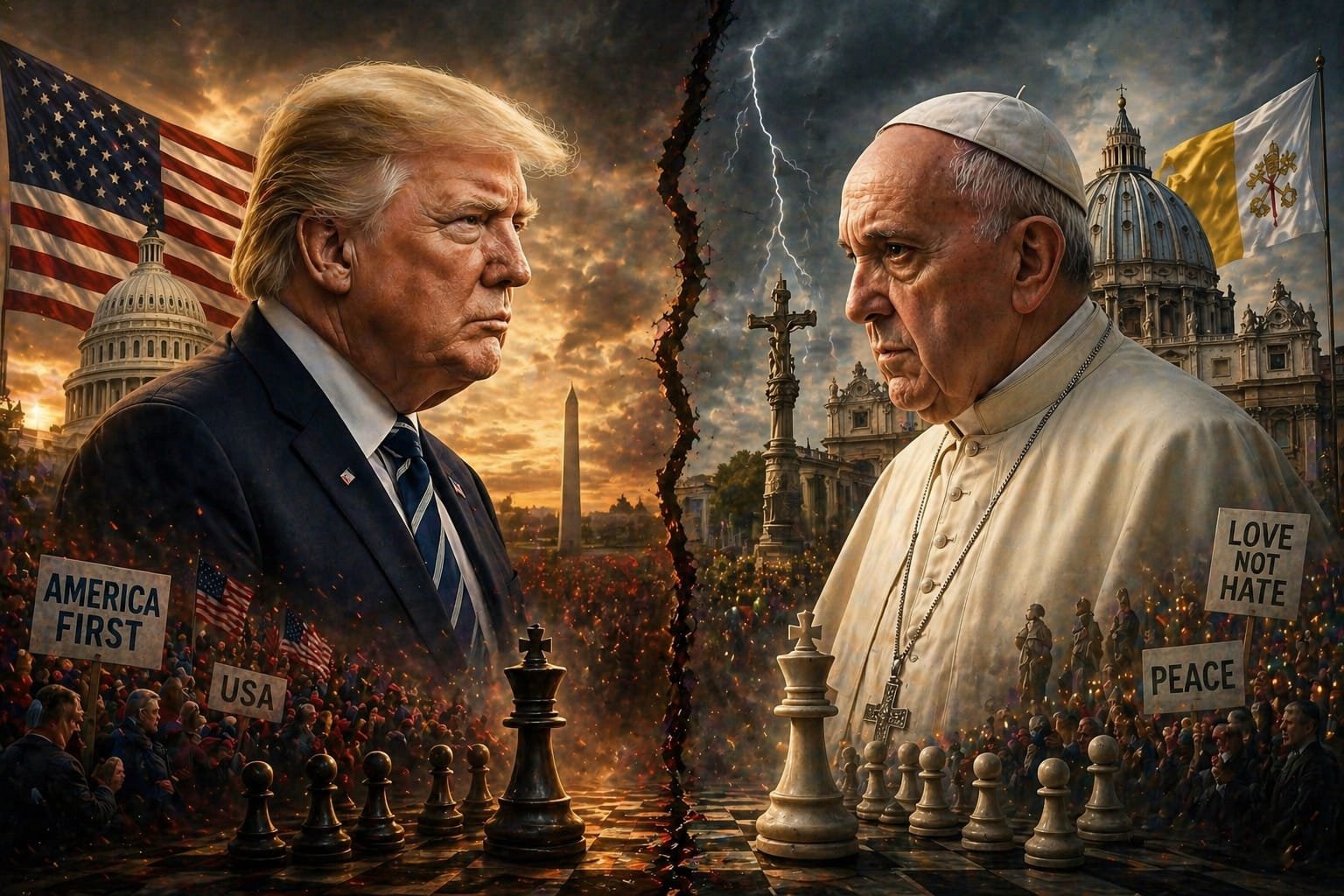
What happens when the most powerful person in government gets into a fight with the spiritual leader of over one billion people on Earth? You get the biggest and longest-running conflict in modern history between Donald Trump and the Pope. It is a story that begins with building a wall along the Mexican border and mass deportations, and now has come to a boiling point about war in Iran. It’s religion against politics. Raw. Unfiltered. No referee.
Most political conflicts die down after a few weeks. This conflict has been raging for ten years and growing louder. Why? Both men represent something far larger than themselves. Trump speaks for a kind of nationalism that doesn’t make excuses for its views on how countries should be run. The pope (first Francis, then Leo XIV) speaks for 1.4 billion Catholics and a vision of human dignity that makes no exception for citizenship status. When these two worlds collide, there are shockwaves from church to newsroom to polling place.
This is that story. All of it. From the first spark in 2016 to today’s smoldering feud.
As of 2013, a new pope had recently been elected from Argentina, Jorge Mario Bergoglio (who would take the name Francis), and Donald Trump, although still a well-known business personality, but not an elected official, tweeted that he liked the newly elected Pope, “He is a humble man, very much like me, which probably explains why I like him so much.”
In retrospect, this was essentially the peace before the storm.
Three years later, Donald Trump announced his candidacy for president, promising to build a wall along the U.S.-Mexico border. As Pope Francis returned from Mexico to Rome, he was directly asked by the media about Mr. Trump’s proposal. The response of Pope Francis was both direct and destructive: “A person who thinks only about building walls, wherever they may be, and not building bridges, is not Christian.”
A person who thinks only about building walls and not building bridges is not Christian. Pope Francis, February 2016
Trump responded quickly. He described the comment as “disgraceful,” and then said it was inappropriate for someone with religious leadership to ask about another person’s faith. In addition, he made this shocking and unbelievable comment: If ISIS were to attack the Vatican at some point, the Pope would have only wished and prayed that Donald Trump had been President of the United States.
This confrontation established what would happen throughout. This would not be an under-the-radar diplomatic dispute where both sides are out of sight. This would be public, loud, and very personal.
Did You Know?
Have Trump and Pope Francis met in person? Only one time. It occurred during an approximately thirty-minute meeting of the two leaders at the Vatican in May of 2017. One picture taken from that meeting quickly went viral. Trump was smiling, while Francis looked somber. The reaction from people to see this photo was widespread. While the meeting of Trump and Francis took place, after it, Trump wrote on his social media platform (Truth Social): “He was something. We had a great meeting.” As reported by some news outlets, Francis allegedly thought otherwise.
To understand where we are today, you need to trace the arc of this battle. It didn’t happen overnight; it built up, year by year, across two Trump terms and the papacies of two very different men.
Key Events: Trump vs. The Vatican
2013
Pope Francis was elected. Trump praises him on Twitter, calling him “humble, very much like me.”
Feb 2016
Pope Francis says anyone building walls “is not Christian.” Trump calls the remark “disgraceful” and threatens to let the Vatican be overrun if he’s not president.
May 2017
Trump visits the Vatican. The meeting is cordial but tense. The viral photo of Trump grinning, Francis stone-faced, becomes iconic.
Jan 2025
The day before Trump’s second inauguration, Pope Francis called Trump’s mass deportation plan “a disgrace.” He says, “This won’t do. You don’t resolve things this way.”
Feb 2025
Francis sends a formal letter to U.S. bishops. He describes deportations as “a major crisis,” invokes the story of Jesus as a refugee in Egypt, and directly challenges VP Vance’s theology on immigration.
Apr 2025
Pope Francis dies on Easter Monday, April 21, aged 88. Trump orders flags to be flown at half-staff and calls him “a good man.” JD Vance had visited Francis just one day before his death.
May 2025
Cardinal Robert Prevosta, a Chicago-born American, was elected Pope Leo XIV in the conclave. An American pope. Unprecedented in history.
Apr 2026
Trump attacks Pope Leo XIV on social media, calling him “weak on crime” and “terrible at foreign policy” over the Iran war. Leo responds, saying he has no interest in debating the president.
Immigration is at the heart of many differences when it comes to this conflict; however, these differences aren’t simply based on politics, they have roots in religious beliefs.
President Trump’s stance has long been clearly stated. National sovereignty is paramount, and borders need to be enforced. Any individual entering another country without proper documentation is breaking the law, and the State has an obligation to enforce its laws by removing those individuals from the country. President Trump’s administration implemented a deportation program unlike anything seen before in America.
Pope Francis had a different view of immigration, a viewpoint which he made clear. When Pope Francis issued his open letter to U.S. Bishops in February 2025, he used a powerful image in Christian faith. He depicted Jesus, Mary & Joseph as refugees escaping into Egypt after King Herod. The point was unmistakable. Removing or deporting the weak and vulnerable is damaging to the dignity of “many men and women” and their families.
Vice President J.D. Vance added another dimension to the conflict as well, with his use of Christian theology to publicly support the administration’s immigration policy. Vance stated that individuals should put their family and neighbors above foreign nationals and therefore love them first.
Pope Francis immediately fired back. “Christian love,” he wrote, “cannot be expressed through concentric circles where one progressively adds the interest of others.” This was a formal slap-down, via written letter from the head of the largest religion on Earth.
New York Cardinal Timothy Dolan, who is decidedly not progressive, referred to Vance’s previous claims regarding government funding for immigration-related programs for Catholic churches as “scurrilous” and “nasty”. If conservative U.S. cardinals are distancing themselves from a current VP, then there must be some serious fault lines running beneath the surface.
Francis’ view on this issue: Refugees escaping poverty and persecution are deserving of dignity, not prosecution. Nations have every right to protect their borders; they do not have the right to dehumanize those attempting to cross said borders.
Trump’s view: Illegal immigration is a crime. Mass deportations are legal, necessary, and a matter of national sovereignty. No religious organization has the authority to interfere with federal law enforcement.
The Church’s response: As part of its efforts to respond to Trump’s immigration policies, more than two dozen religious organizations filed suit against DHS (Department of Homeland Security) relating to immigration enforcement around houses of worship. These include, among others, the Episcopal Church, Reform Jewish Congregations, and Mennonite Church USA.
Response from Trump’s Border Czar Tom Homan: In response to Pope Francis’ written letter calling out Trump’s immigration policies, Homan stated simply: “The Pope should just keep to himself and fix that.”
When Pope Francis passed away on Easter Monday, April 21, 2025, many expected that the tensions between the Vatican and Washington could relax with a new pope. Since the next pope will be chosen through a conclave of cardinals, it is likely to be a more diplomatic candidate than the previous one.
Instead of choosing someone from another country, or even within Rome, the College of Cardinals chose Robert Prevost of Chicago. This is an American. For nearly two decades, he worked as a missionary in Peru, where he immersed himself in Latin American social justice traditions. As pope, he chose the name Leo XIV.
Initially, Trump appeared to be pleased with this decision. However, his initial approval was short-lived.
Following a joint Israeli/U.S. bombing of Iran beginning in early 2026, Pope Leo XIV became one of the most vocal anti-war figures globally. Pope Leo XIV expressed outrage with the violence. In addition to calling for peace, he took an unprecedented stance against all global leaders using “religion to justify military action.”
Pope Leo XIV’s statements were immediately responded to personally by Trump through social media. Trump stated that Leo is “weak on crime” and “weak on foreign policy.” Trump also made claims questioning Leo’s legitimacy due to his election being solely based upon him being an American citizen.
Leo refused to escalate. He stated this aboard the Pope’s plane while on an African tour; “The speech of mine about peace,” he said, “was written approximately two weeks prior to Mr. Trump’s attacks.” “It seems like I’m trying to argue or ‘debate’ again with the President,” Leo continued. “That is absolutely not my intention.”
Mr. Trump, in response, reinforced his stance. In a somewhat remarkable (historically) statement, Mr. Trump indicated that he has the authority to disagree with the Pope. This type of comment by a U.S. President would be historic today; it received little attention in the current media.
We have to remember this crisis isn’t limited to the United States; it’s a global geopolitical struggle with players from around the world participating.
International diplomacy can be thought of as a game of chess. The President of the U.S. sits at the middle of the board and represents the greatest amount of military and economic influence in the world. The Vatican, however, is a unique player. It has no weapons, no tariffs on foreign trade, and no aircraft. All the power of the Vatican lies in its ability to bring people together through its moral authority and symbolism. Yet time and again in polls conducted by reputable polling organizations (Reuters/Ipsos), Pope Leo XIV receives higher approval ratings than President Donald Trump, not only among the American people, but also globally.
According to a Reuters/Ipsos poll, approximately 60% of all Americans polled expressed their approval for Pope Leo. Approximately 36% expressed their approval for how well President Trump was performing his job. In comparison, among Catholic Americans (who make up approximately 20% of the electorate and are heavily represented in key swing states), nearly 84% viewed Pope Leo positively, according to data collected by Pew Research.
This is not the first time a government official has had trouble with the church; there are many examples throughout history of those who have fought against the papacy, including Henry VIII, who broke away from Rome, or Napoleon, who humiliated Pope Pius VII, or President Nixon, trying to navigate diplomatic efforts by the Vatican through the Vietnam War.
The difference this time around is that the battle between Trump and the Pope is unfolding in public view for all to see via social media, with millions of people watching, sharing, and reacting immediately. A Trump-supporting Catholic voter from Pennsylvania named Anita Bauman was blunt in her assessment about Trump’s attack on Pope Francis: “Picking a fight with the pope is colossally stupid.”
Even some of Trump’s most ardent supporters have begun to speak up as well. In fact, one young man who recently converted to Catholicism likened the current state of affairs to the Avignon Papacy (the period of time when the French Monarchy exerted control over the Roman Catholic Church) and stated that seeing so many Catholics give their allegiance to a secular authority rather than to a religious authority has been very discouraging.”
Fairness and fairness are required for any honest assessment, which means we need to recognize that the relationship between Donald Trump and the American Catholic Church is more complicated than a simple oppositional or even mutually antagonistic relationship; there are several areas where the interests of Trump and the American Catholic Church intersect.
Abortion:
Trump chose three justices to sit on the US Supreme Court, which led to the decision to overturn Roe vs. Wade. Overturning Roe has been a major objective of many leaders within the hierarchical structure of the American Catholic Church since its initial ruling in 1973.
Religious Freedom:
The Trump Administration repeatedly supported religious freedom protections in all forms of public life. The U.S. Conference of Catholic Bishops has also identified the protection of religious freedom as one of its key objectives.
Secularism:
Both Trump and the Catholic Church expressed similar concerns regarding what they view as an increasingly aggressive secular movement attempting to eliminate religion from public life.
Communism:
While both the Catholic Church and Trump have taken differing positions on communism (the Catholic Church views communism as incompatible with Christianity), they do agree on the treatment of religious individuals under communist governments. Specifically, both have expressed strong anti-communist sentiments against China and Venezuela based upon those countries’ treatment of religious groups.
Historian Steven Millies, at the Catholic Theological Union, said: “U.S.-Vatican relations involve more than just two people.” There is no single unified voice within the American Catholic Church. While progressive voices may be less supportive of President Trump, he finds much support among traditionalist and conservative voices within the American Catholic Church.
Strip away all of the headlines, the social media posts, the viral photos, and the theological debates, and what we are really left with is a timeless question: Should religious institutions play a role in political affairs?
Must religious leaders remain silent while tending to the spiritual and allow politicians to utilize the authority of government for purposes that they believe will lead to suffering for those most vulnerable?
Catholicism has long had an answer to this query as well. For over 2 millennia, Catholics have been engaged in dialogue with Kings, Emperors, Presidents, etc. As such, the Church views a shepherd’s responsibility as one who speaks up on behalf of his flock if it is threatened. And Pope Francis has acted upon that view. Likewise, Pope Leo XIII is acting upon that same view today.
On the other hand, Trump has provided another answer that also has merit. Elected Governments create public policies. All governmental institutions (including judicial, religious, and international) should respect the democratic mandate of the people. In addition, Trump states that the people elected him. Similarly, he believes the Cardinals elected the Pope. Each institution should be able to govern according to its own sphere of influence.
Each perspective reflects fundamental values held by hundreds of millions of Americans. It is because both perspectives are fundamentally true that this conflict is both so heatedly debated and so vital.
The world is being ravaged by a handful of tyrants, yet it is held together by a multitude of supportive brothers and sisters. Pope Leo XIV, Bamenda, Cameroon, April 2026
As of April 2026, the conflict between Donald Trump and the Catholic Church continues to intensify. The ongoing United States-Iran War has taken this internal church dispute from being centered around issues of border disputes and turned it into a struggle over bombing.
Pope Leo XIV is the first American-born pope in recorded history. Instead of taking the traditional Vatican approach of using ambiguous language as a way to avoid direct confrontation with the current U.S. political climate, Pope Leo has used his unique voice and culturally fluent communication style to speak directly to the current U.S. political reality. That audience is paying attention.
Donald Trump, for all intents and purposes, remains defiant, aggressive, and unconcerned with the institution’s prestige. He referred to Pope Francis as “a good man” just after he passed away. Since then, he has attacked Pope Leo on social media almost daily. He claims he has the right to be opposed to the pope. Perhaps he does.
History never forgets its past. History typically does not treat those people well who place their own self-interest ahead of human decency.
Disclaimer: This article is for informational and educational purposes only. It reflects analysis based on publicly available geopolitical developments and does not constitute prediction or professional advice.
Want More Guides on Political Leadership? Check out this One
