Newsletter Subscribe
Enter your email address below and subscribe to our newsletter

Enter your email address below and subscribe to our newsletter

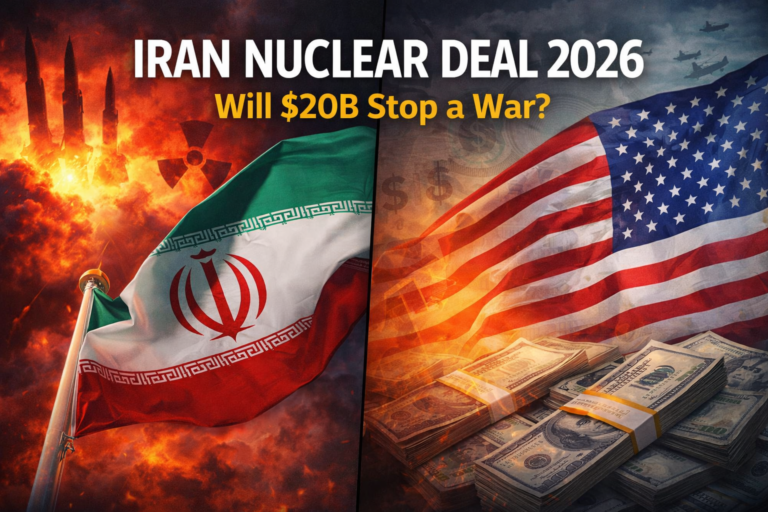
Iran is asking for much more than sanctions relief from the West. Iran is asking for $11 trillion in assets that have been frozen since 1979 and 46 years’ worth of compound interest on those frozen assets.
If that happens, then the Strait of Hormuz will remain closed. This is no bluff based solely on desperation but rather a strategic, legally argued, geopolitical decision based on grievances that date back many years.
To understand how important this issue is and to see why it affects you even if you can’t locate a map of the Persian Gulf, you need to go all the way back to 1979.
The fall of the Shah during the Iranian Revolution in 1979 created a serious situation in the United States. A major part of the connection to America included U.S. banking institutions, military contracts, and reserve accounts. Following the chaotic months after the fall of the Shah, Washington essentially “froze” almost $12 billion dollars worth of Iranian assets (i.e., blocked access). This action was justified based on the then-current hostage crisis involving Iranians at the U.S. Embassy in Tehran.
In exchange for the resolution of the hostage crisis, the Algiers Accords were signed in 1981. As a result of these accords, some funds were returned; however, Iran states, and many other international law experts believe that much of the funds were never properly accounted for or included in the amounts which were repaid, as the value of those funds would be today after growing for nearly five decades.
To illustrate this example, assume that someone locked up your savings account in a vault in 1979 and returned it to you without earning any interest in 2025. You would lose money, but also lose a lifetime of financially developing your earnings. That is basically Iran’s position when expressed in plain terms.
In terms of political events, there wasn’t a specific time or event that caused the Iranian assets dispute. Rather, it has been a result of a series of long-term political decision-making actions, broken treaties/agreements, and sanctions. Here is what can be described as the simplified history:
1979
Islamic Revolution. Assets held by the government of Iran were frozen by the United States. The hostage crisis at the U.S. embassy began.
1981
Algiers Accords signed. In exchange for some of its assets being returned to Iran, the Algiers Accords agreed that all future disagreements would be resolved through negotiations. However, Iran claimed that the settlement process was coercive and left many issues unresolved.
1996-2012
Sanctions against Iran imposed by both the United States and the United Nations for Iran’s nuclear weapons development program continued to be enacted. With each successive round of sanctions, oil revenue and the ability to utilize the services of global banks continued to decrease.
2015
JCPOA (Joint Comprehensive Plan of Action) was implemented. Under the agreement, Iran limited its nuclear weapons development capabilities; sanctions were lifted. Although the amount of money that was unfrozen under the JCPOA is estimated to be around $150 billion, the U.S. estimates it to be significantly lower.
2018
U.S. withdrew from the JCPOA. The “maximum pressure” sanctions were reinstituted by the U.S. against Iran. Iran’s economy declined dramatically due to increased restrictions on its financial transactions.
2023-2025
Escalating nuclear tensions between Iran and other nations. Uranium enrichment levels in Iran have accelerated. Frozen asset requests, which are currently valued at approximately $11 trillion with interest, have become an increasingly important topic in international relations.
The Strait of Hormuz (the narrow waterway connecting the Persian Gulf with the Gulf of Oman) is located at the northern end of the Gulf of Oman between Oman and the United Arab Emirates and at the southern end by Iran. All of the large tankers carrying oil and liquefied natural gas produced in Saudi Arabia, the United Arab Emirates, Kuwait, and Qatar travel through this very narrow part of the sea to reach global markets.
While Western nations are also dependent on oil supplies passing through the Strait of Hormuz (although less so than other regions), it would be Asian nations that would experience the greatest economic shock if oil and liquefied natural gas could no longer flow through the Strait.
Approximately 90% of Japan’s oil comes into Japan through this waterway. Likewise, both South Korea and China have significant oil supply dependences, as does India. While the immediate price increase for gasoline in London and New York resulting from an inability to use this waterway would be minimal compared to what people experienced during previous oil shortages, the impact on the supply chain for factories in Osaka, farm inputs in Punjab, and industrial production in Guangdong would be substantial.
Technically, yes; however, Iran has spent years developing an asymmetric warfare doctrine that will provide it with an advantage in terms of attacking through the Strait of Hormuz. Iran has developed various capabilities to achieve this objective, such as:
However, whether Iran’s strategy would be successful is another matter. Closing the Strait of Hormuz would likely lead to a US-led military action against Iran. However, it appears that Iran believes that the threat of closing the Strait of Hormuz is a much stronger diplomatic tool than closing it. After all, diplomacy is similar to playing chess using pieces that you may or may not ever use.
This is when we get into some very real complexities about the Iranian asset demand and why so much of the Western media’s coverage misses the mark.
There really are grounds for an Iranian asset demand based upon a legitimate (albeit disputed) legal and financial context.
The Compound Interest Argument
The value of the frozen assets was approximately $12 billion in 1979 dollars. Applying an average annual return of 7-8 percent (this represents a reasonable estimate of what US Treasury bonds and major stock indexes generally provide) for 46 years results in extremely large numbers. These estimates have been made by both Iran’s economic team and its legal counsel. Therefore, the $11 trillion is not simply an estimate but rather an estimation of the current value of the funds that have been normally invested since 1979.
Will this likely represent a maximum negotiating position? Likely. However, it seems unrealistic to dismiss such a figure as pure fiction without recognizing the legitimate economic grievances underlying such a figure.
International Legal Precedent
Iran has also prevailed in its claims against the United States at the International Court of Justice. For example, in 2023, the ICJ determined that the U.S. had to remove restrictions placed on certain Iranian State-Owned enterprises due to restrictions imposed pursuant to the 1955 Treaty of Amity. The fact that the ICJ is willing to consider Iran’s claims has added legitimacy to Iran’s legal strategy internationally.
You don’t have to be an expert in geopolitics to understand the economics involved. All you have to do is understand what it means if 20 percent of the world’s oil supply cannot find its way out to consumers.
Immediate Economic Impact
Oil prices will rise, estimates are as high as $200+ per barrel in the event of a long-term closure.
Global inflation will increase due to the previous global supply chain shock.
Increases will occur immediately in aviation fuel, shipping costs, and manufacturing input costs.
Many emerging market economies, which are experiencing current debt pressures, may experience a currency crisis.
Medium- Term Structural Change
Iranian relations with Asia (China and India) would become increasingly difficult as these countries attempt to maintain diplomatic relationships with both the US and Iran.
Additionally, we should consider whether or not a Strait of Hormuz crisis would cause a shift away from the dollar as the dominant currency. Iran has been attempting to establish “oil-to-yuan” trade agreements and alternative payment systems. A Strait of Hormuz crisis that reveals the limitations of Western countries could give increased support to those attempts.
Iran has already made threats regarding the Strait of Hormuz in the past. In 2012, while there was intense nuclear rhetoric, Iranian officers announced they would close the Strait of Hormuz if Western nations escalated sanctions against them. The markets reacted poorly, but nothing occurred.
Then, why should we believe that the next threat will be credible?
There are three reasons why the situation surrounding Iran in 2025 differs dramatically from when there were similar threats in 2012:
Firstly, Iran’s military capability has developed greatly since 2012. Their drone program has proven itself in several recent regional conflicts and demonstrates greater precision and distance than their drones did ten years ago.
Secondly, the international diplomatic scene is much less organized today. The JCPOA (Joint Comprehensive Plan of Action) is effectively dead. Communication between Washington and Tehran through back-channels has also become thinner. The institutions that existed prior to this time to reduce tensions are weaker.
Finally, Iran now has new strategic relationships. Since sanctions increased against Iran in 2018, the relations between Iran and Russia/China have grown stronger. This gives Iran a buffer zone within the global economy and security system that does not currently exist.
Negotiated settlement
A partial asset release is negotiated through a new diplomatic process (possibly with mediation from Oman, Qatar, or China) that includes both nuclear and Strait of Hormuz-related commitments. Most likely, this will be the best result as it is also the hardest to achieve.
Standoff continues
Neither party gives way on their positions. Sanctions continue. The Strait of Hormuz remains open but at risk of closure at any moment due to threats. Energy prices are adjusted to include an ongoing cost for the risk of the Strait of Hormuz being closed. The “slow boiling” continues.
Partial closure or harassment
Iran does not completely block the straits; there is an increase in harassment of ships. This can take many forms, such as ship seizures, mine incidents, or drone encounters. There has been an example of this already in the past year, and it may become even more intense.
Complete Blockage/Military Conflict
Worst case. While unlikely now, it should not be discounted entirely. If this happens, it could lead to profound changes in the way countries interact with each other on a global basis.
On one hand, the Strait of Hormuz frozen assets standoff is a simple two-country conflict; however, at its core, the standoff is an international test of whether all countries (regardless of economic status) will receive equal treatment within the international financial/legal systems, or if economic strength dictates which country receives redress for their grievances.
Iran’s claim of $11 trillion may never be paid. The Strait of Hormuz may never be closed. However, the discussion has begun, and as such, the underlying issue of nearly 46 years of frozen sovereign wealth, accumulated interest, and the determination of reasonable compensation for restitution is not disappearing.
The next time that you see crude prices skyrocketing, and there are many “experts” trying to figure out why, do not forget that somewhere in a very small body of water located off the coast of Iran/Oman, much of our country’s past 40-plus years of financial history are quietly having an effect.
Disclaimer: This article is for informational and educational purposes only. It reflects analysis based on publicly available geopolitical developments and does not constitute prediction or professional advice.
Want More Guides on International Affairs? Check out this One