Newsletter Subscribe
Enter your email address below and subscribe to our newsletter

Enter your email address below and subscribe to our newsletter
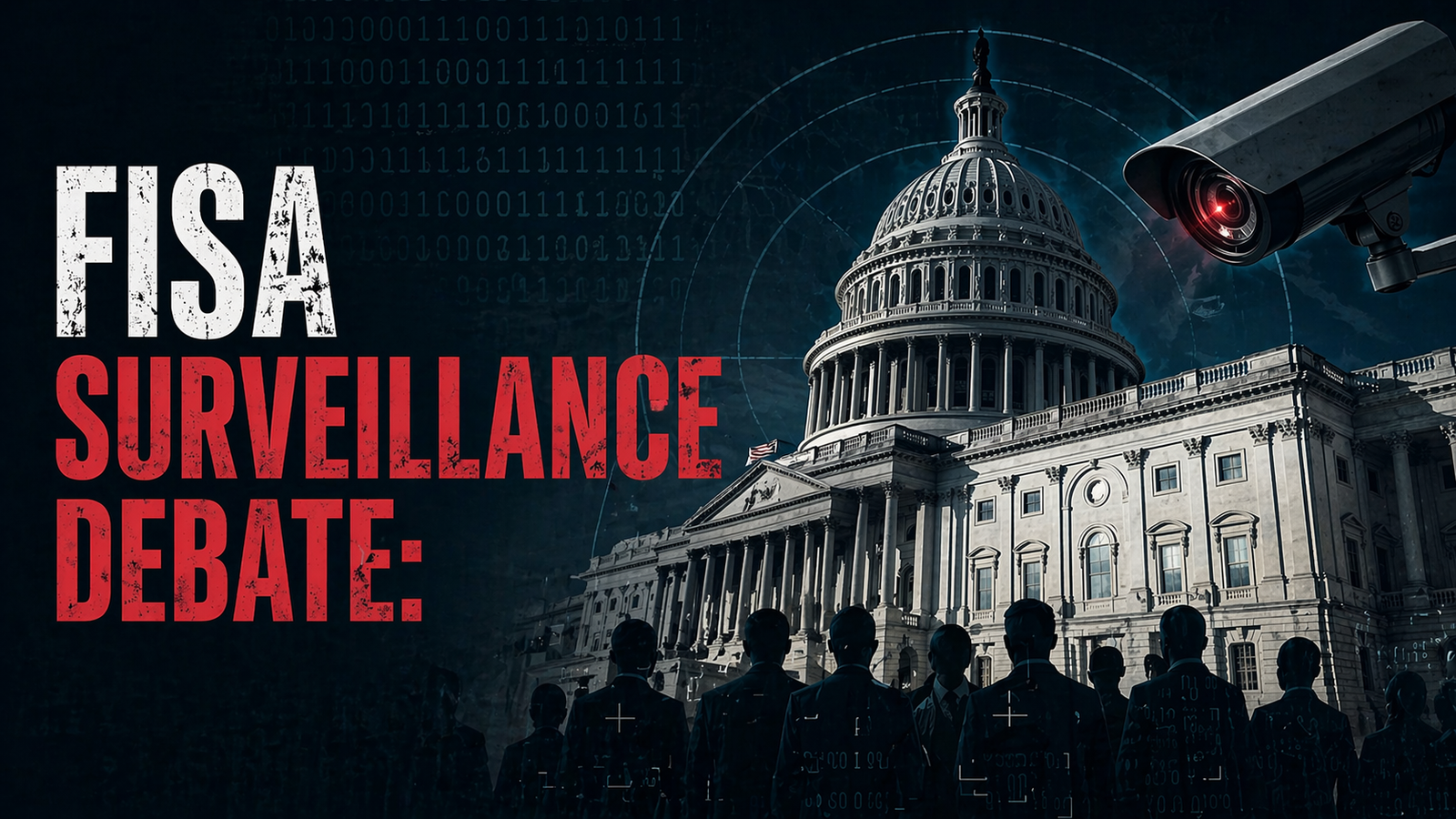
Imagine that someone is monitoring your communications. However, I don’t mean your telephone calls; you would probably notice those. I mean your email communications, your searches, and the metadata of every single communication you send digitally. Even though you do not see them, they are being monitored. If you were to ask the U.S. Government whether they are monitoring your communications, the U.S. Government may tell you “we cannot confirm,” which translates to yes. This is not some movie plot; this is FISA. FISA has been the foundation for the United States’ surveillance/intelligence gathering since 1978.
The FISA controversy has been debated for quite some time. Approximately every 2-5 years, there is an event such as a leak, court decision, or Congressional renewal vote that brings the controversy back into the public eye. Each time this occurs, the same basic question comes to mind: Where does national security stop, and where does the abuse of power by the federal government begin?
This issue is not simply a Democrat vs. Republican issue. Both liberals/conservatives and both pro-security advocates/pro-privacy advocates have loved and hated FISA at various times throughout history. When this happens, it usually indicates that a particular issue goes beyond party politics and speaks to something fundamentally important about what a democratic society should look like.
In this article, we’ll explore FISA’s beginnings in the Cold War era, Edward Snowden’s revelations regarding FISA, and current battles over FISA in Washington, D.C.
FISA (Foreign Intelligence Surveillance Act) is a U.S. Federal law that defines the legal methods for conducting both physical and electronic domestic surveillance of foreign powers and/or their agents operating in the United States. The act was signed by President Jimmy Carter on October 25th, 1978. This allows American spy agencies to legally follow and collect information from foreign sources operating domestically; prior to FISA, there were virtually no rules governing such actions.
Even though you are likely outside the U.S., you may still have reason to be interested in this topic because the U.S. has the largest, most interrelated international intelligence community. Programs initiated by the National Security Agency (NSA), based upon authorization received through FISA, do not end once one crosses into another country. Due to the fact that an extremely high amount of international internet traffic passes through servers located within the U.S., FISA could potentially apply to data collected in countries around the globe. As many of you use Google (Gmail), WhatsApp, Facebook, etc., you utilize some part of the infrastructure associated with these services.
It was not only the FISA that created a judicial system to enforce its rules. The FISA also created a specific judicial body called the Foreign Intelligence Surveillance Court (FISC). The FISC is often referred to as the “FISA Court.” It is a special and secretive court comprised of federal judges. These judges decide on whether or not to grant government applications for surveillance orders directed at foreign intelligence targets.
Critics of the current state of the FISA process refer to the FISA Court as a “rubber-stamp” court. Advocates of the FISA process defend the FISA Courts’ historically low rates of rejection by pointing out that the Justice Department is extremely diligent in reviewing and screening each application before making a request. Therefore, both sides can make legitimate arguments about the effectiveness of the FISA process.
“Whoever controls the definition of ‘foreign agent’ controls the boundary between protected speech and criminal surveillance.”
Legal scholars on FISA’s definitional ambiguities
To fully comprehend what FISA represents, you need to know where it originated. That begins with the tumultuous 1970s. The war in Vietnam, which caused widespread distrust of government among many citizens; the Watergate scandal that exposed President Richard Nixon for using his intelligence services to suppress opposition to his administration; and a Senate investigative committee led by Senator Frank Church (the Church Committee) that disclosed decades of unauthorized spying at home conducted by both the Federal Bureau of Investigation (FBI) and Central Intelligence Agency (CIA).
The results of the Church Committee investigations were disturbing. The FBI used COINTELPRO, a program designed to disrupt civil rights organizations such as the Southern Christian Leadership Conference, targeting their leaders, including Dr. Martin Luther King Jr., through a variety of means, including spying on them, attempting to blackmail them, and even sending Dr. King an anonymous letter suggesting he take his own life. The CIA possessed detailed dossiers about every American citizen. The National Security Agency (NSA) intercepted international communications with no oversight of any kind by the judiciary.
Congress created FISA as a result of these findings. As envisioned, the concept behind FISA was simple. If the government wants to conduct surveillance on someone located within the United States to gather information related to foreign intelligence gathering activities, then it would be required to obtain a warrant, but it wouldn’t have to do so from a regular court or judge. Instead, it would seek a warrant from a special secret court that understood how sensitive intelligence work could be. The law established a middle ground between having no oversight and full disclosure of all intelligence activities.
If we think of FISA as a building, then Section 702 would be the meeting room in which all of the arguments occur. When introduced through the FISA Amendments Act of 2008, Section 702 allows the U.S. Government to obtain the communications of individuals from outside the U.S., provided that they are non-U.S. Persons.
This sounds sensible on paper. The NSA wants to review the email of an overseas suspected terrorist. There is no need to protect that type of communication in the same manner that there would be for a domestic citizen.
The issue here is that the Internet does not recognize geographical boundaries. Thus, when the NSA collects communications related to a targeted foreign person, it will often capture the communications of U.S. citizens who communicated with or spoke about that foreign person. This is known as incidental collection, and this is where many civil libertarians find serious concerns with Section 702.
This part of the problem becomes much more difficult. Under Section 702, the FBI can legally look through collected data by using an American name or identifier as long as the FBI does not obtain a new warrant. Advocates for greater privacy rights refer to this as the “back door search loophole”. They say this loophole allows the United States Government to essentially search Americans’ communications without giving them the Fourth Amendment protection their communications should be entitled to.
Whether Section 702 has thwarted real terrorist attacks is not the issue here. It most likely has. The issue at hand is whether the price paid (in loss of privacy and in eroding of our Constitutional norms) is commensurate with what we got back. That’s not a technical issue. That’s a values issue. And America still hasn’t addressed it completely.
June 2013: An NSA employee (29 years old) named Edward Snowden contacted two journalism organizations (The Washington Post and The Guardian) with an enormous cache of classified information and left for Hong Kong. After that, the world began to take notice.
It is now well established that the NSA has engaged in spying on citizens at a level much greater than Congress or the general population was aware of. Programs such as PRISM allow the NSA to capture data directly from the servers of major U.S. technology corporations (Microsoft, Google, Apple, Facebook, etc.), and another program called XKeyscore can be used to search large amounts of internet usage records (emails, browsing history, chat logs).
All programs have legal authority provided via FISA.
The negative reactions from countries around the globe began immediately after the story broke. Germany’s Chancellor Angela Merkel (her cell phone reportedly had been tapped by the U.S.) spoke out against U.S. actions to President Barack Obama and cancelled a planned visit to meet with him in person. Brazilian President Dilma Rousseff also canceled her trip to meet with President Obama and brought up issues related to the surveillance at the United Nations’ General Assembly. Due to these revelations, Safe Harbor, an EU/US privacy agreement, was ultimately declared null by the European Court of Justice.
The issue cannot be framed simply as an American issue. While the U.S. has the world’s largest and technically advanced surveillance state, there are other intelligence-gathering states. Intelligence sharing agreements such as the “Five Eyes” (U.S., U.K., Canada, Australia & New Zealand) enable participating countries to exchange surveillance information across borders, which may limit their ability to meet their respective domestic laws and regulations regarding surveillance.
China’s surveillance apparatus also operates on far fewer regulatory or legal constraints than that of FISA. In addition to requiring telecoms companies to provide direct access to all communications via the SORM system, Russia’s Federal Security Service (FSB) also has authority for “real-time” monitoring of internet traffic. The differences in these examples lie not in the fact that democratic governments do not collect intelligence; rather, they are expected to operate intelligence-gathering programs in accordance with the law, including oversight mechanisms and accountability.
The current debate over whether FISA achieves its intended goal of providing accountability to democratic society ultimately centers upon whether democratic societies can effectively limit their own national security institutions after they have been created.
One of the least discussed aspects of the FISA debate is how technology companies fit into this discussion. Following the Snowden disclosures, many tech companies such as Apple and Google implemented End-To-End (E2E) Encryption across their platforms driven in part due to competitive pressures; E2E has also been seen as a way for these companies to demonstrate their concern for customer data security; and finally E2E offers these companies additional protections from law enforcement agencies who may be seeking to compel them to assist in the decryption of encrypted communications.
The U.S. Government did not agree on the merits of E2E. In 2015, FBI Director James Comey argued that because E2E was causing “the going dark” of legitimate investigative opportunities, he believed E2E should be prohibited. This argument was most clearly demonstrated when Apple declined a Federal Court Order in 2016 requesting that the company provide technical assistance to the FBI in unlocking the iPhone of the San Bernardino killer. Apple framed its refusal as creating a dangerous precedent for the security of millions of customers around the world.
This battle over whether law enforcement can have access to information via surveillance or whether individuals can encrypt their communications will continue to be one of the most significant technology policy debates of the twenty-first century, and FISA will sit right at the heart of this ongoing struggle.
Following the revelations made by Snowden, the U.S. saw true momentum toward reform of the Foreign Intelligence Surveillance Act (FISA). A key example is the passage of the u.s.a Freedom Act of 2015, which put an end to the National Security Agency’s bulk collection of phone metadata – one of the most publicly criticized programs revealed through Snowden documents. This was actual, substantive reform. Critics were quick to point out that this bill was also carefully written to protect the majority of the surveillance apparatus as it existed prior to Snowden.
Every re-authorization battle since has centered upon section 702 of the FISA amendments act. In 2018, Section 702 was renewed with very few amendments. The re-authorization process in 2024 was especially contentious. For instance, for the first time in years, a coalition of parties with different views on the topic formed across party lines to advocate for both reform and retention of the existing structure. Ultimately, Congress approved the renewal of section 702 with several new requirements, but without the warrant requirement that privacy advocates had long advocated for regarding “backdoor” searches of Americans’ communications by Intelligence agencies.
Changes made:
Things that did not change:
The fundamental tension:
While intelligence agencies claim that requiring warrants would introduce undue delays in responding to emerging threats in real time, civil liberties organizations say that the United States Constitution does not provide for exceptions to the Fourth Amendment based on “undue delays.”
The U.S. FISA reform debate also suffers from asymmetry issues.
On one hand, the federal government understands its use of FISA and what it does with that authority. On the other hand, the U.S. public does not understand the use of FISA or how FISA operates.
Thusly, proponents advocating for reform are fighting against classified information they cannot access, creating inherent inequality within the political discussion surrounding reform.
FISA has been a tough dilemma for democratic governments since it was created. Threats from terrorism, foreign espionage, cyber-attacks, etc., exist, and failure to watch out for those threats means failure as a citizen.
However, FISA is also an example of the slow growth of FISA court interpretation, and the use of surveillance authority outside of public discourse or congressional authorization. Although the FISA court, intended to serve as oversight, granted approval on 33,900 request applications, and rejected only eleven (11) requests, what was originally designed as “targeted” surveillance of foreign agents ultimately became surveillance of millions of everyday U.S. citizens communicating with others abroad.
Democratic systems rely on checks and balances. However, checks do little good unless there is someone performing them. The most significant question that this FISA debate requires is not whether surveillance is needed. Rather, the question is: Are the institutions established to supervise that surveillance capable of limiting surveillance that crosses constitutional lines?
If you review the past honestly, the answer is no; therefore, this is a valid reason to lose some sleep regardless of which nation is conducting the monitoring.
Disclaimer: This article is for informational and educational purposes only. It reflects analysis based on publicly available geopolitical developments and does not constitute prediction or professional advice.
Want More Guides on Contemporary Politics? Check out this One