
Newsletter Subscribe
Enter your email address below and subscribe to our newsletter

Enter your email address below and subscribe to our newsletter
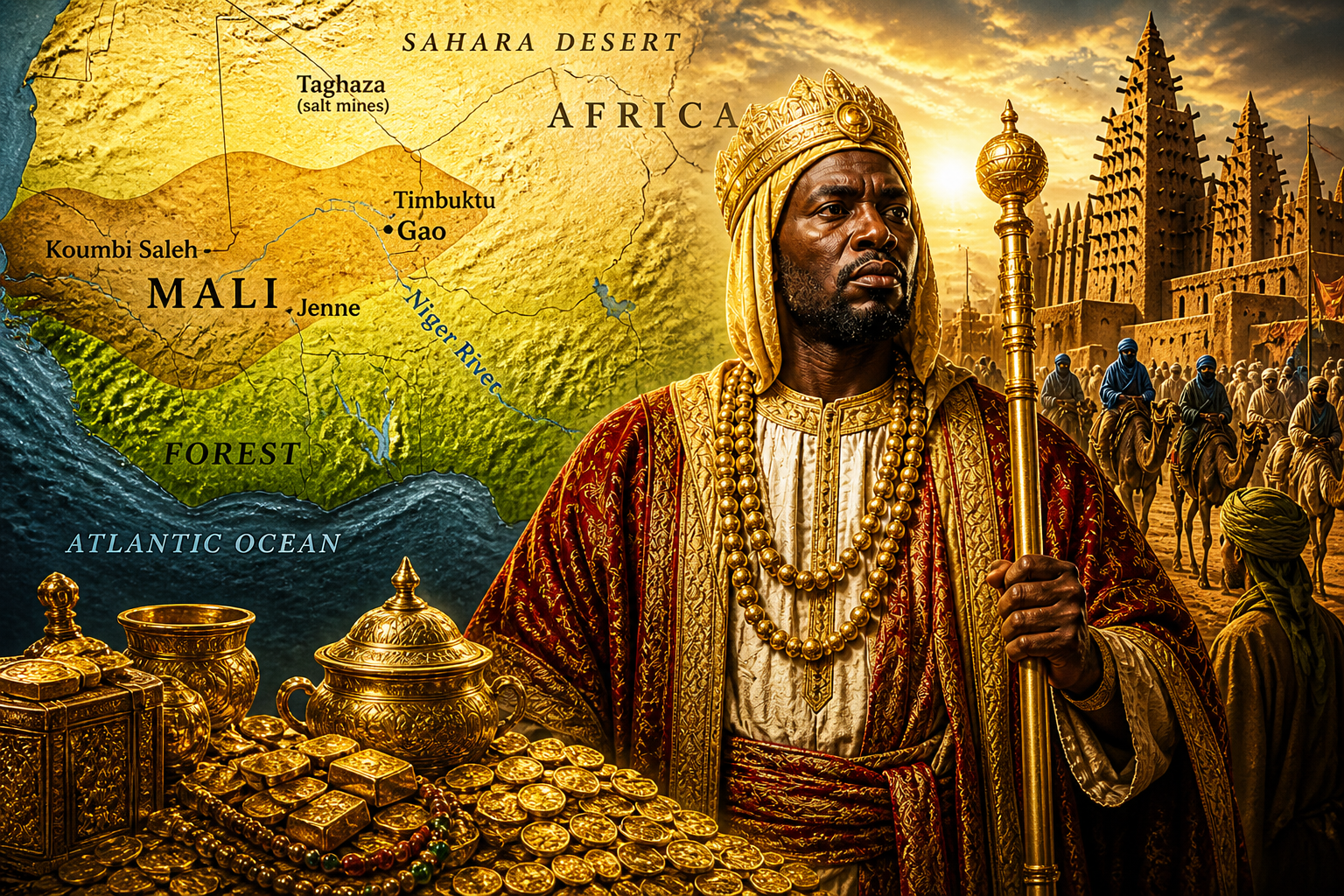
What comes to mind when you think of an incredibly wealthy kingdom that caused a collapse in the global economy just because its ruler (an Emperor) went on a foreign trip and handed out too much gold to everyone he met? That king wasn’t overthrown by another country. There were no trade or economic sanctions imposed on his kingdom. The reason for this is simple: the king was Mansa Musa, and the nation that Mansa Musa ruled was called the Mali Empire. Without debate, the Mali Empire was among the greatest powers in the medieval world.
But somehow, the vast majority of our school books skip over this incredible story.
I am saying there is no legend here. I am referring to a gap in world history as the “superpower” of Mali. This chapter in world history has many examples of unbelieveable wealth; revolutionary scholarship; innovative forms of government; and levels of diplomatic relations with other countries at the same time that European nations could not match.
Why do we rarely speak about it? And what can it tell us about money, and how does money translate into the ability to be influential globally? Let’s look closer.
The Mali Empire, also referred to as the Manding Empire or Manden Kurufaba, rose to prominence in Western Africa during the early 13th century. At one point, this large empire covered an enormous amount of space, which is now comprised of parts of many countries, including Senegal, Gambia, Guinea, Guinea-Bissau, Côte d’Ivoire (Ivory Coast), Mauritania, Mali, and Niger.
Think about that for a moment. One empire. Eight modern nation-states. That is not a regional power house; that is a superpower on the continent.
The empire was created by the legendary warrior-king Sundiata Keita in approximately 1235 CE, immediately following the Battle of Kirina. The empire expanded quickly due to a combination of military expansion, forming strategically beneficial alliances with neighboring kingdoms, and controlling major trans-Saharan trade routes. The empire did not simply focus on gaining control over land. They focused on obtaining leverage through their control of two key commodities: gold and salt. These two commodities are worth billions in today’s money.
Before Suniata became the Empire, he became the Legend.
Sundiata Keita, or “the Lion King of Mali,” has been perhaps the most influential historical figure. When he was young, he could not even walk because of a medical condition. People who were enemies of Sundiata made fun of him for being disabled. His family was forced out of their homeland. All signs pointed toward Sundiata fading away into nothingness.
However, this did not happen.
Sundiata gathered together many tribes and defeated his enemy at the Battle of Kirina.
Although the Manden Charter was created by the people of Mali in 1220 C.E., it had elements that would be considered modern today. For example, slavery was forbidden, no person could lose their private possessions except under specific circumstances, and everyone had the right to live. However, the Magna Carta, which is widely credited with establishing the basis for all individual freedoms, was created by English nobles in 1215 C.E. The Manden Charter and the Magna Carta were both created during a period of roughly 10 years before and after each other and were located in different parts of the world.
When Sundiata created the empire, Mansa Musa was what put the world on notice.
Mansa Musa ruled Mali from approximately 1312 until his death in 1337. He is generally regarded as the wealthiest person in recorded history. The estimated net worth of Mansa Musa at today’s dollar value is anywhere from $400 billion to more than $1 trillion. To give you some idea, that is greater than the entire GDP of France.
However, having wealth does not make an empire great. It is the way Mansa Musa chose to utilize his wealth that sets him apart.
The Hajj That Changed History
Between 1324 and 1325, Mansa Musa went on the pilgrimage to Mecca, which will be remembered as one of the greatest events in the medieval period.
Mansa Musa did not go quietly. As reported, his entourage consisted of:
During his travels through Cairo and various cities, Mansa Musa gave away such large quantities of gold that historians believe gold prices in Egypt remained depressed for over a decade.
It was not Mansa Musa who attempted to create economic warfare. Rather, he believed giving away that much money was nothing. This is another example of the type of power available to leaders, and this type of power can be used very effectively as soft diplomacy.
This was a form of geopolitics demonstrated not by military might but by economic weight. Does this sound familiar? Think about how modern-day superpowers use both financial assistance and sanctions to influence international relations via financial means. Mansa Musa was using a similar approach over seven hundred years earlier, long before it was standard practice among nations.
I am sure you have heard about Timbuktu almost always as a distant place. Yet, for many years, Timbuktu was the greatest center of higher education in all of recorded history.
During the Mali Empire, under the leadership of Mansa Musa, Timbuktu was one of the great seats of knowledge in the world. During this period, Timbuktu became the great intellectual center of Islamic law and study, mathematics and astronomy, and literature.
As such, the Sankore Madrasah or University of Sankore received tens of thousands of students from all over Africa, the Middle East, and even from Europe.
It is estimated that by the height of its power, Timbuktu’s universities possessed an incredible 700,000 manuscripts. At this time, the Vatican’s archives had less than half of these documents. Courses were taught in:
Power encompasses more than simply military force and geographic control.
To achieve real, sustainable power, an economy must be developed, and a system for exchanging goods must exist. The Mali Empire understood this better than almost anyone else did.
The Mali Empire existed at the intersection of the trans-Saharan trade routes. These are the historical avenues of exchange that connect Sub-Saharan Africa to North Africa, the Mediterranean Sea, and from there to Europe and Asia.
The Mali Empire collected taxes on all items passing through its borders; these include but are not limited to: gold, salt, kola nuts, copper, and enslaved persons.
Important trade centers within the scope of the Mali Empire’s influence include:
This was not simply due to geography. The Mali Empire actively impacted international trade by regulating access, determining conditions under which trade would take place, and utilizing its gold monopoly to economically dominate other regions. In contemporary terminology, this can be described as resource-based diplomacy.
Active diplomatic relationships were maintained between the Mali Empire and Morocco, Egypt, and the Arab Sultanates. Diplomats were sent back and forth between empires. Treaties were signed. Trade agreements were formally documented. This was truly complex international relations in every practical sense of the term.
The Mali Empire did much more than simply go out and conquer other nations; it created a great deal of societal sophistication by creating a structure for society.
The power structure of the Mali Empire was decentralized as opposed to having strict central control. The Mali Empire created systems known as “vassals” or “conquered kingdoms,” which allowed them to create local governments, yet pay tribute (tax) to the empire and acknowledge its authority. This is similar to how a franchising company operates; the parent corporation creates the overall guidelines and charges each of its franchises a fee for operating under its name. However, the individual franchises are able to operate independently on a daily basis.
The benefits of this type of governance included lower costs for governing, less resistance from local areas due to the fact that local control remained intact, and rapid expansion. Additionally, the ability for the empire to be resilient was greatly enhanced since unrest in one area did not have to automatically affect the rest of the empire.
Islamic laws were imposed upon the people of Mali after the Islamic conquest of West Africa, and many pre-Islamic matrilineal traditions survived. In his book, “Travels in Asia and Africa,” Ibn Battuta, the famous Moroccan traveler who traveled through Mali in 1352 CE, reported that the Malian women enjoyed greater freedom and greater social standing than women in other parts of the Islamic world.
All levels of society were able to engage in trade. There existed merchant guilds in Mali, and there existed a sense of social mobility among the people. That is, if you worked diligently enough and engaged in commerce, you would be elevated in terms of your social standing.
No empire is indestructible. The Mali Empire declined for several reasons, including internal conflict (succession crisis), external pressures (the growing Songhay Empire), and the inherent difficulty of ruling over such an expansive territory without some form of modern communication system or logistical support.
Some of the key factors in the empire’s decline include:
By the end of the 15th century, the Mali Empire was significantly smaller than it once was. By the early 17th century, the Mali Empire was virtually non-existent.
Decline does not eliminate legacy. The Roman Empire fell. The British Empire collapsed. The Ottoman Empire broke apart. We continue to study all three empires because they are fundamental to our understanding of how we got to where we are today. The Mali Empire should receive the same type of study.
This is much more than simply learning about an empire that existed in the past. Learning about the Mali Empire directly relates to many conversations we are currently engaged in about Africa’s place in today’s global economy, about how those writing history create and determine which stories to tell and whose to ignore, and about how power works.
Africa’s Economic Resource Base
It is no secret that West Africa (the same area where the Mali Empire flourished) is home to large deposits of Gold, Lithium, Bauxite, Uranium, and other important economic minerals. As such, the battle for control over access to and ownership of these strategic natural resources is increasing at an unprecedented pace. Governments around the globe, including China, France, the United States, and Russia, are all seeking to exert their influence over the West African Region.
Learning about the Mali Empire provides insight into why this part of the world has always been and will continue to be a critical component of global power dynamics.
Problems with Removing History
For hundreds of years, the Mali Empire was virtually unknown to students and scholars outside of the continent of Africa. This lack of knowledge was not coincidental. Narratives of African civilizations have long been deliberately suppressed or diminished by historians to justify colonialism and the transatlantic slave trade.
Today, as scholars, students, and researchers seek to reclaim histories of Africa, the Mali Empire is proving to be one of the best examples of what actual African Civilization looks like: complex, rich, diplomatic, and intellectually vibrant.
Mali’s Empire did not exist as a side note but rather as an International headline. At its peak, the Mali Empire held control over the world’s gold supplies. They also had universities that brought students from three different continents to study with them. They created and practiced diplomacy on a level beyond what anyone could have imagined at that time. And then there was Mansa Musa, who was so wealthy that he gave away enough money through charity to break entire local economies.
But this story of the Mali Empire as a superpower is not simply about ancient Africa. It is about the nature of power itself. How do we construct historical memory? And finally, how is our understanding of the world shaped by the stories we choose to tell and those we don’t?
We typically speak of great empires and powers as being Rome, China, or Persia. Perhaps it is now time to include Niani, Timbuktu, and Mansa Musa in that discussion. Because they were always meant to be included.
Disclaimer: This article is for informational and educational purposes only. It reflects analysis based on publicly available geopolitical developments and does not constitute prediction or professional advice.
Want More Guides on Political History? Check out this One
